Last checked November 2026
Live oaks hung with Spanish moss are Savannah's picture postcard, and homeowners ask about the moss and the ferns on their oaks more than anything else. The short answer: neither one kills the tree. The extension services explain both, along with the things that do wear down Savannah's oaks.
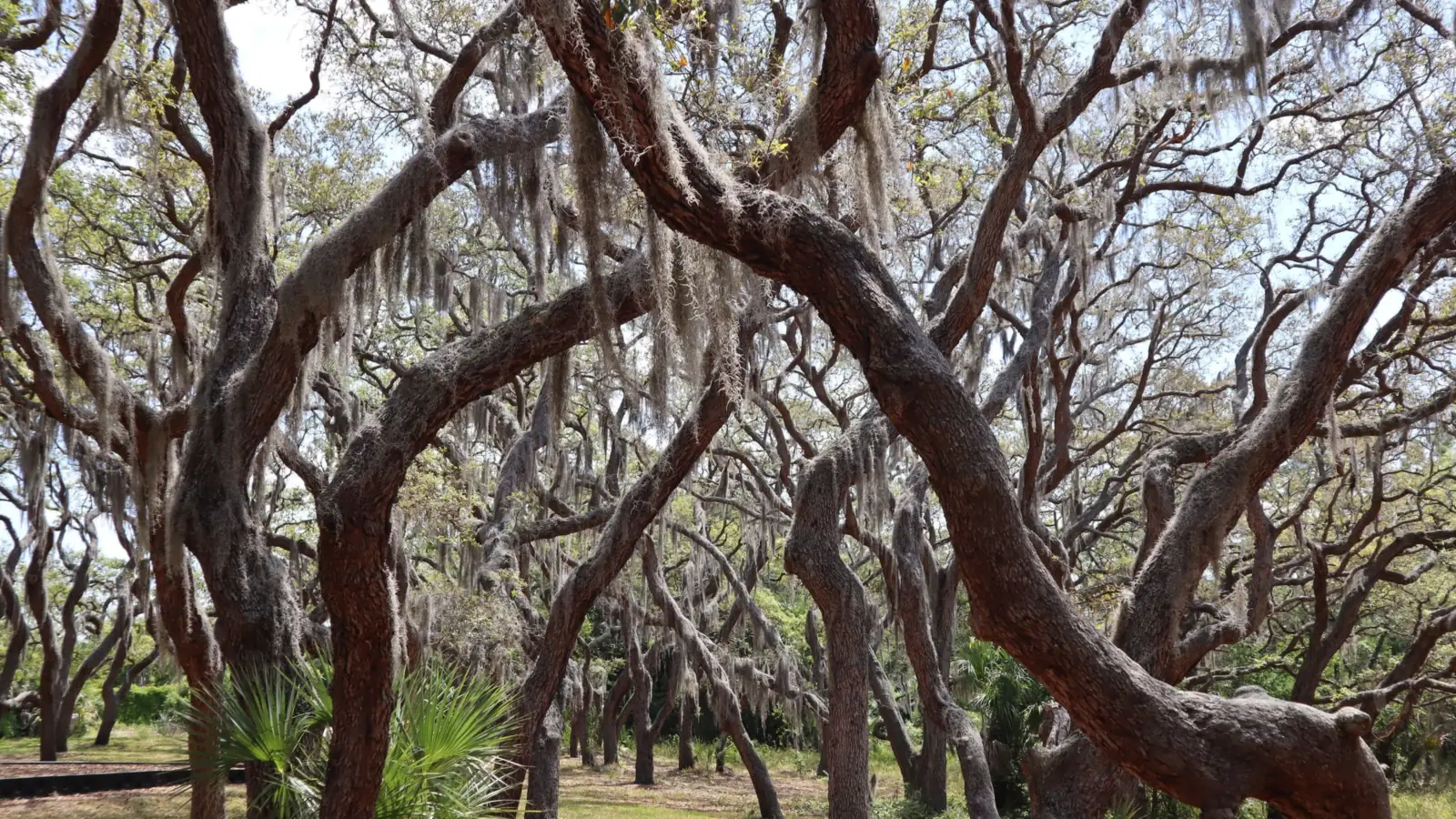
Spanish moss isn't a parasite
UGA Extension says Spanish moss uses the tree only for support and makes its own food. It isn't a moss at all: UF/IFAS places Spanish moss and ball moss in the bromeliad family. Heavy growth can shade some leaves, but UGA calls it harmless to trees in general.
Moss shows up thick on weak, thin-crowned trees because it likes light, which leads people to blame it for the decline. UF/IFAS says the moss doesn't cause the decline and adds little weight, so it almost never breaks a branch. Copper-based moss sprays exist, but there's evidence they damage tender oak growth.
Resurrection fern and lichens
Resurrection fern grows on oak limbs and can lose about 75 percent of its water in a dry spell, curling brown, then turns green again after rain. It takes no nutrients from the tree and draws moisture from the bark surface. Lichens work the same way, living on water and nutrients from the air.
Mistletoe is the exception. It's a true parasite that takes water and minerals from its host, and oak is among its hosts. A crew can prune out limbs that carry it.
Built for the coast
Southern live oak is Georgia's state tree, reaching 60 to 80 feet tall with a spread of 60 to 120 feet. Its waxy leaves resist salt spray, and the U.S. Forest Service notes it grows to maturity on sites hit by hurricane-force winds. UF/IFAS gives it high wind resistance, but young trees need training to remove narrow-angled branches that can split later.
The real threats to Savannah's oaks
The Savannah Tree Foundation points to street compaction, traffic pollution and heat stress. Much of downtown's canopy went in during the late 1890s and early 1900s, and the foundation says most urban live oaks live about 150 years, so many will age out around 2040. Savannah's park and tree staff told Garden & Gun the city is replacing its 15,000 or so public live oaks with saplings as old trees fall.
At Wormsloe on Isle of Hope, car and truck traffic on the avenue compacts the roots of oaks planted in 1891. The same thing happens in a driveway or a parking pad under a backyard oak.
Protecting your live oak
- Mulch under the crown and plant nothing, grass included, inside the dripline, as UGA Extension in coastal Camden County advises.
- Keep cars, trucks and construction equipment off the root zone.
- Don't pile soil over the roots. Savannah's ordinance bars grade changes inside a protected tree's root zone beyond two inches of mulch without city approval.
- Plan sidewalks and slabs with room to spare. Clemson Extension notes live oak roots lift paving planted too close.
- Prune long, heavy limbs from the ends instead of making big cuts near the trunk.
Sources
- UGA Extension Bulletin 999, slime molds, Spanish moss, lichens and mistletoe
- UF/IFAS, Spanish moss and ball moss
- UGA Extension Paulding County, ferns
- UF/IFAS Nassau County, resurrection fern
- UF/IFAS, Quercus virginiana fact sheet
- Clemson HGIC, live oak
- USDA Forest Service, live oak silvics
- Garden & Gun, Savannah's iconic oaks (2024)
- MPC-hosted Savannah Tree Foundation presentation (2024)
- WTOC, plan to help save Wormsloe's oaks (2021)
- UGA Extension Camden County, trees and turf